Before I start, I am going to repeat this again. I know I have explained about this before but before I can move to the actual point, I need to explain this again. The one main thing that got me attracted to the MkVII Tricorder was its blinking lights. It was the main reason I persevered with my Electronics Degree when I realised I really wanted to go into Industrial Design.
The Heart of the Blinkies
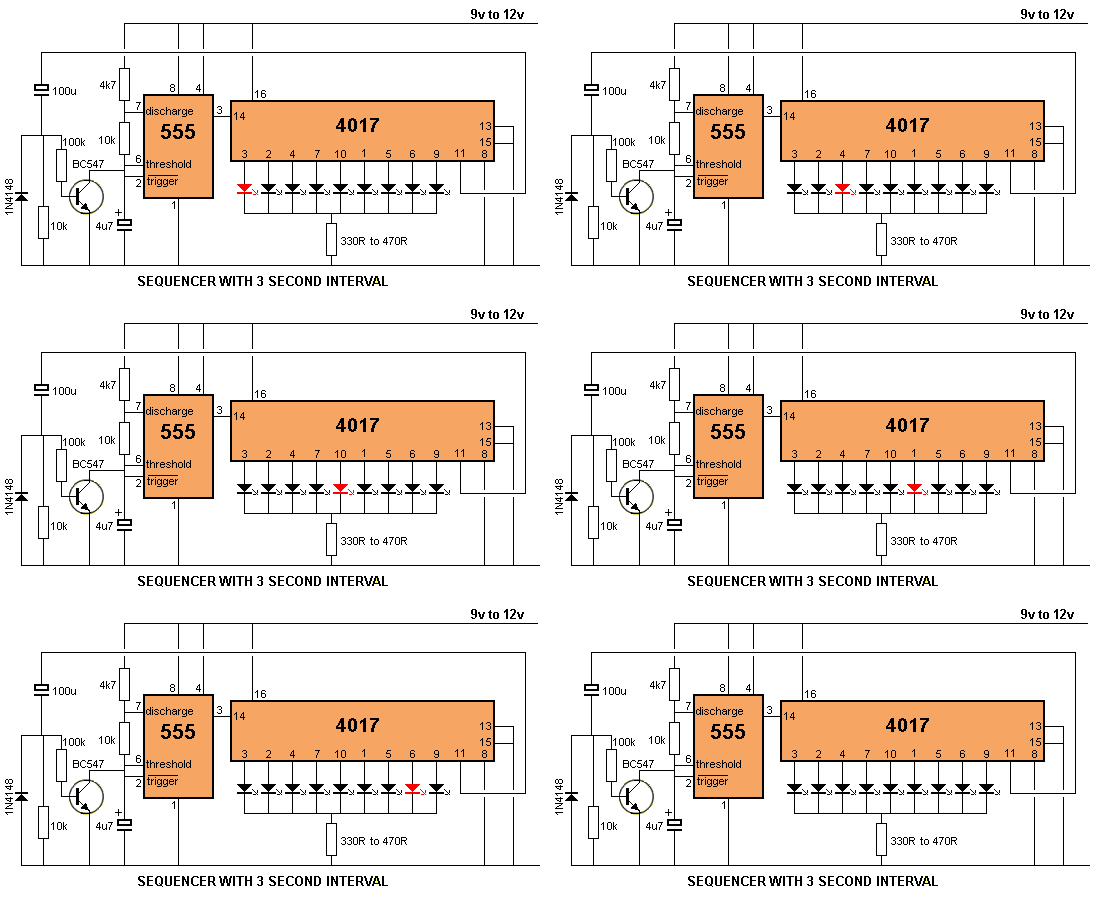
The lights in the Tricorder blinks in a 4-step sequence on repeat, which can be replicated with modifying a 555/4017 circuit. This is, to me, the Heart of most TNG props that requires ‘Running lights’. I did not realise the potential of that circuit until I put 2 and 2 together after seeing the Tricorder in action, read some Datasheets and also, thanks to some Forums, kicked my lazy butt. The modification is to connect the pin#10 to pin#15 in the 4017 IC. This makes the 4017 decade counter count up to four and on the fifth step, resets itself without any delay. Otherwise, the 4017 on a normal setup would count up to ten before it resets itself.

From the image above, there are four green indicators on the left of the Tricorder’s screen and they are labeled (from top to bottom) Alpha, Beta, Gamma and Delta. Depending on how they are wired for the show, the sequence can either start from the top or from the bottom. It is just the matter of wiring the LEDs. Sometimes you will notice that the speed of the sequence varies and that can be done by varying the resistance of the 555 timer. I suppose the said timer is crucial because how long the lights come one and goes out, depends on the two resistors and one capacitor.
Anyway, it is easy to just use the 555/4017 circuit to light up the whole Prop. But when I looked at the video below, the sequence does not support the theory. The sequence of the Alpha, Beta, Gamma, Delta and the rightmost three LEDs are not in sync.
(Screen Used MkVII Tricorder courtesy of Popology101.)
To show you what I mean, look at the sample chart below. Let’s say, when the ALPHA LED is on at positions K2 to L2 (R2-S2, X2-Y2, AD2-AE2), LED #2 (A8) should be lit. But it is not so as if you look at the three LED sequence in rows 7,8,9 each time these LEDs light up, they are not sychronised with the LEDs in rows 2, 3, 4 & 5. Whether this is true or not I cannot confirm it since my method of sampling is not accurate; it was just me pressing the spacebar at the right interval as best as I can.


